Why High-Level Executives Are Trading Their Notebooks for the reMarkable Paper Pure
The executive thinking problem
Most leaders don't lack intelligence or experience. They lack protected thinking time. A calendar full of meetings, an inbox that never empties, and a phone that vibrates through the quiet moments that are supposed to be for reflection. The higher up the org chart you go, the more people compete for your attention. And the more your actual job requires you to think clearly, the less time you get to do it.
Physical notebooks have always been the fallback. They don't buzz. They don't pull you into email. But they get left in the office, the pages aren't searchable, and there's no system behind them. You fill notebooks that never become anything more than filled notebooks.
The Paper Pure fixes the notebook's limits without adding the laptop's liabilities. Everything you write is organized, searchable, and syncable when you need it. And while you're writing, nothing else is competing for your attention.
Board preparation and PDF annotation
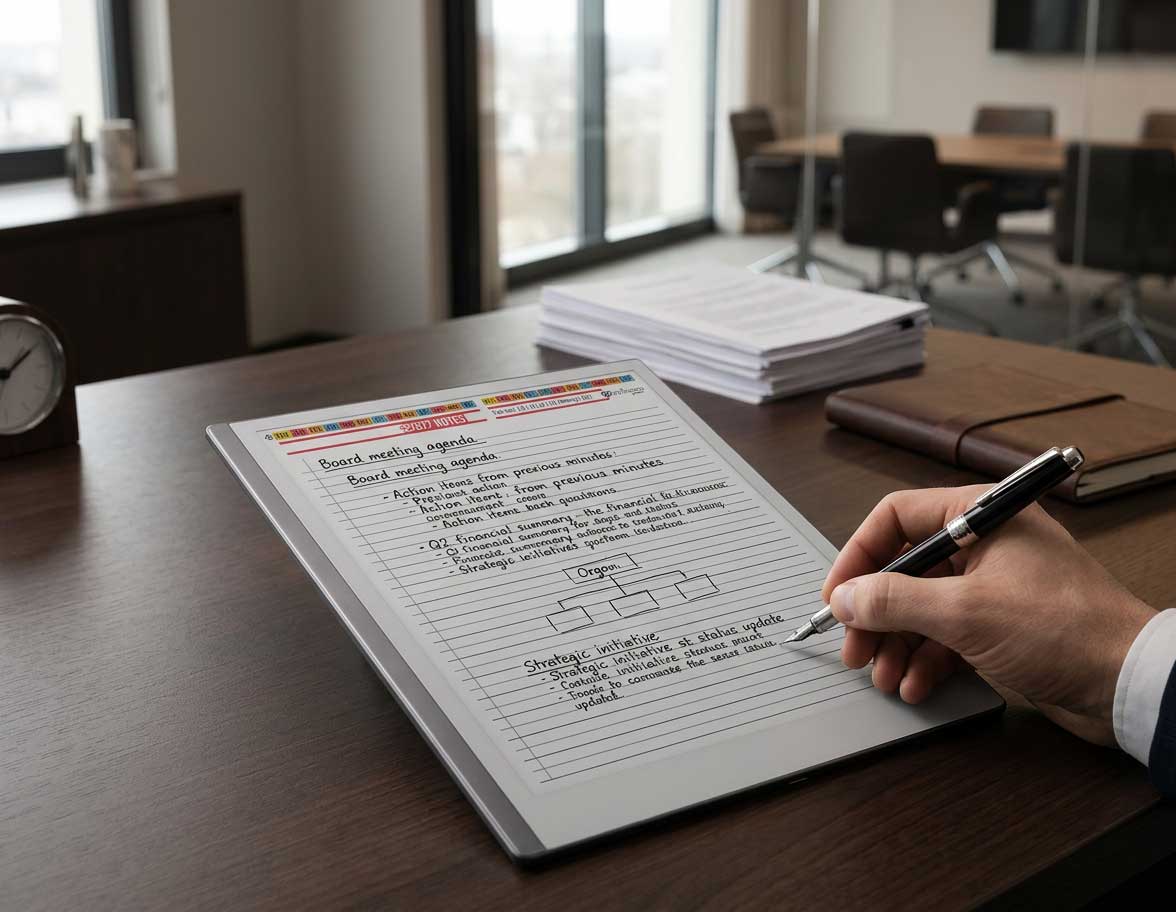
Board decks are PDFs. Every executive who's ever prepared for a board meeting knows the ritual: print the deck, mark it up by hand, show up with notes in the margins. The Paper Pure does this without the paper.
Import the board deck as a PDF. Annotate directly on the device. Write your talking points in the margins, flag slides that need context, mark the numbers you'll be challenged on. The annotation tools are precise, the latency is near-zero, and because the Paper Pure operates offline unless you actively sync, sensitive materials stay off shared cloud services until you choose otherwise.
After the meeting, those annotations stay organized by document. Next quarter's prep starts where this quarter's left off.
The decision journal every executive needs
The single most underused leadership tool is a decision journal. Not a task list, not a meeting log. A record of the significant decisions you make: the context, the options you considered, the reasoning you used, and the outcome you expected.
Reviewing a decision journal six months later shows you things you can't see in the moment. Where you were confident and right. Where you were confident and wrong. What information you relied on that turned out to be incorrect. What your blind spots cost you.
Decision journal format (K2S Executive tier)
Decision: What specifically are you deciding?
Context: What's the situation that makes this decision necessary now?
Options considered: What did you actually think about? Not just the one you picked.
Reasoning: Why this option over the others?
Expected outcome: What do you think happens if you're right?
Review date: Set a 90-day reminder to come back to this entry.
The K2S Executive tier includes a structured decision journal framework. Keeping it on the Paper Pure means it's never on the same device as your email and Slack. That matters. When the journal is on a general device, it competes with everything else. On the Paper Pure, it's protected.
Strategic planning at the right altitude
Annual planning and quarterly reviews require a different kind of thinking than daily operations. You're not processing information. You're constructing a picture of where things are, where they need to go, and what the organization is capable of.
That kind of thinking doesn't happen well in a 45-minute meeting or a shared doc that six people are commenting on in real time. It happens in protected blocks of time, with a writing surface that slows you down just enough to think clearly.
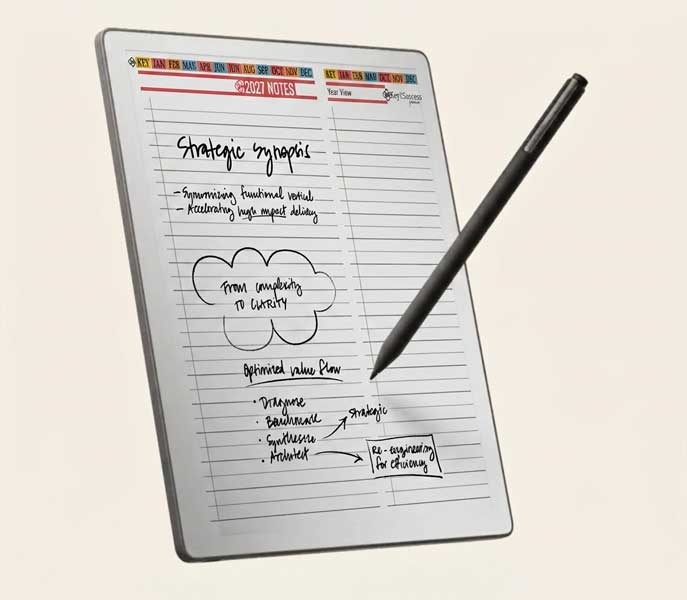
The K2S Executive tier includes annual vision and quarterly planning frameworks. Write the strategic picture by hand first. What do you actually believe about the next 12 months? Where are you most uncertain? What would have to be true for the plan to hold?
Writing those questions and answering them on paper before building a presentation or sending a memo produces better thinking than starting in a doc. The hand forces a different kind of attention than the keyboard.
Leadership communication and pre-meeting clarity
The executives who communicate most clearly in meetings and presentations are usually the ones who did the most preparation off-screen. They thought through the message before they delivered it. They wrote it down, found the places where it broke down, and fixed it before anyone else heard it.
Use the Paper Pure before important conversations. Write what you're trying to accomplish. Write the one thing you need the other person to understand. Write the objection you most expect and what you'd say to it. That five-minute exercise changes how you show up.
Get the K2S Executive Planner for reMarkable Paper Pure
Strategic vision, decision journaling, quarterly planning, and leadership frameworks. Built for the complexity of running an organization.
Shop Executive PlannerFrequently asked questions
Sources
- reMarkable User Research Data (2024). Focus and Stress Outcomes vs. PC Work. remarkable.com
- Van der Meer, A.L.H. & Van der Weel, F.R.R. (2017). Only Three Fingers Write, but the Whole Brain Works. Frontiers in Psychology. frontiersin.org